Foosball is one of those games that can turn an ordinary afternoon into a competition within minutes. The only problem is that a full-size foosball table can take up a surprising amount of space. It can be difficult to fit one into a small apartment, bedroom, dorm room, office, or family room.
That is where tabletop foosball comes in.
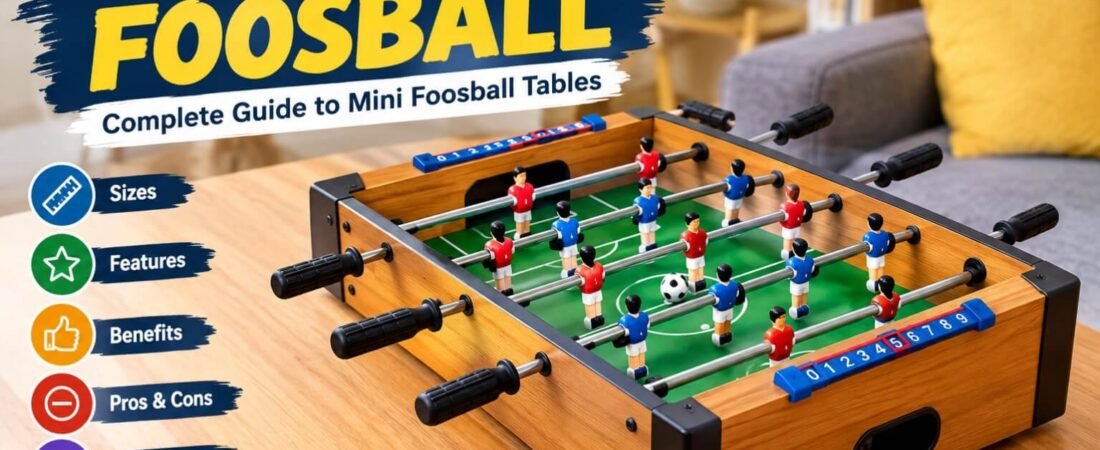
A tabletop foosball table is a smaller version of a traditional foosball table designed to sit on top of a sturdy table, desk, counter, or other flat surface. It provides the basic foosball experience without requiring a dedicated game room or a large floor area.
Tabletop models are especially popular with children, beginners, families, casual players, and people who want something portable and easy to store. They are also an affordable way to introduce someone to foosball before investing in a full-size table.
However, not every tabletop foosball table offers the same playing experience. Differences in construction, rod quality, player figures, playing surface, stability, and size can have a major effect on how enjoyable the game feels.
This guide explains everything you need to know about tabletop foosball, including how it works, its advantages and disadvantages, typical sizes, important features, setup tips, maintenance, and how to choose the right model.
What Is a Tabletop Foosball Table?
A tabletop foosball table is a compact foosball game designed to be placed on another elevated surface rather than standing on its own legs.
Like a traditional foosball table, it usually has:
- A playing field
- Miniature soccer players
- Horizontal control rods
- Goals at both ends
- Ball returns or ball retrieval areas
- Rod handles
- A scoring system
The main difference is the size and construction.
A full-size foosball table normally has its own legs and stands at an adult playing height. A tabletop model removes the large legs and reduces the overall size so the game can be played on a table or other suitable surface.
Many tabletop models are roughly 20 to 40 inches long, although there is no single standard size. Some compact models are considerably smaller, while larger tabletop versions can approach the dimensions of a small furniture-style table.
The smaller design makes tabletop foosball much easier to move and store.
How Does Tabletop Foosball Work?
The basic gameplay is the same idea as regular foosball.
Players control miniature football or soccer figures attached to horizontal rods. By moving and rotating the rods, players attempt to control the ball, pass it between their figures, defend their goal, and shoot into the opponent’s goal.
The exact number of rods and players depends on the design.
Some tabletop models have a simplified layout with fewer players and rods than a full-size foosball table. This keeps the table compact and makes it easier for children and beginners to control.
A typical game can be played by two people, with one player controlling each side. Some models can also accommodate four players for doubles-style games.
The smaller playing field means the ball generally moves through the game more quickly, so reactions and positioning can still be important even though the table is much smaller.
Tabletop Foosball vs Full-Size Foosball
The biggest question for many buyers is whether a tabletop table can replace a full-size foosball table.
The answer depends on how you plan to use it.
| Feature | Tabletop Foosball | Full-Size Foosball |
|---|---|---|
| Size | Compact | Large |
| Legs | Usually none | Yes |
| Storage | Very easy | Requires dedicated space |
| Portability | Excellent | Limited |
| Price | Usually lower | Usually higher |
| Playing area | Smaller | Larger |
| Adult comfort | Limited on some models | Better |
| Children | Excellent | Can be difficult for young children |
| Casual play | Excellent | Excellent |
| Competitive practice | Limited | Much better |
| Space requirement | Low | High |
A tabletop model is primarily designed for convenience and casual entertainment.
A full-size table is more appropriate if you want realistic gameplay, extended playing sessions, serious practice, or a table that multiple adults can comfortably use.
Why Are Tabletop Foosball Tables So Popular?
The biggest advantage is simple: they save space.
A traditional foosball table can become a permanent piece of furniture. Once assembled, moving it around the house may require considerable effort.
A tabletop model can usually be picked up, moved, and stored when the game is finished.
This makes it attractive for people who do not have a dedicated recreation room.
Great for Small Homes
If you live in an apartment or a small house, floor space can be valuable.
Instead of giving an entire section of your room to a full-size foosball table, you can store a tabletop model in a closet and bring it out when friends or family want to play.
Easy to Store
Storage is another major advantage.
When the game is over, you can move the tabletop foosball table to:
- A closet
- Under a bed
- A storage cabinet
- A shelf
- A garage
- A playroom
The exact storage method depends on the dimensions of the model.
Easier for Children
Full-size foosball tables can be too tall for younger children.
Tabletop models allow children to play from a more convenient height because the game can be placed on a suitable table.
Parents should still choose a stable surface and supervise younger children, especially around small balls and removable components.
More Affordable
Tabletop foosball tables generally require less material than full-size models.
As a result, they are often less expensive.
That makes them useful for someone who wants to try foosball without making a major investment.
Main Disadvantages of Tabletop Foosball
Tabletop foosball is convenient, but it also has limitations.
Understanding those limitations before buying can prevent disappointment.
Smaller Playing Field
The playing area is much smaller than a full-size table.
That changes the way the game feels.
There is less room for passing, positioning, ball control, and defensive movement. Players who are accustomed to full-size foosball may find the smaller field noticeably different.
Less Realistic Gameplay
A quality full-size table is designed to provide a more realistic playing experience.
Tabletop models are usually built around convenience rather than professional performance.
The rods may be smaller, the players may be lighter, and the playing surface may not have the same characteristics as a tournament-style table.
Stability Can Be an Issue
Because tabletop tables are lightweight, they can move during aggressive play.
This is one of the most important things to consider.
If the table slides across the surface whenever you shoot the ball, the game becomes frustrating.
A heavier tabletop model with rubber feet or non-slip supports can provide a more stable experience.
Not Ideal for Serious Competition
If you are training for competitive foosball, a tabletop model should generally not be your primary practice table.
The dimensions, rod system, player configuration, playing surface, and overall feel can differ substantially from full-size competition tables.
For serious practice, a full-size table is usually more appropriate.
Tabletop Foosball Table Sizes
There is no universal tabletop foosball dimension.
Manufacturers produce different sizes for different audiences.
Many compact tabletop models fall somewhere around 20 to 40 inches in length, but the exact dimensions can vary significantly.
Before buying, always check the manufacturer’s listed measurements rather than relying only on the product title.
Small Tabletop Foosball
Small models are designed primarily for children and extremely limited spaces.
They are easy to carry and store but usually provide the least realistic playing experience.
They can be suitable for:
- Young children
- Small bedrooms
- Travel
- Occasional entertainment
- Small apartments
Medium Tabletop Foosball
Medium-sized models provide a better balance between portability and gameplay.
They provide more room for the miniature players and can feel more comfortable for older children and casual adult players.
Large Tabletop Foosball
Some tabletop tables are relatively large and may approach 40 inches in length.
These models require a larger supporting table but can provide a more enjoyable playing area.
If you want a tabletop model for adults, looking at the larger end of the tabletop category can make sense.
Important Tabletop Foosball Features
Size should not be the only thing you consider.
Two tables with similar dimensions can provide completely different playing experiences.
Here are the features worth checking.
1. Sturdy Construction
The cabinet should feel solid rather than flimsy.
A rigid construction helps prevent excessive movement during gameplay.
Look at the materials used for the cabinet, playing surface, rods, and supports.
2. Smooth Rod Movement
Rod quality has a major effect on gameplay.
The rods should move smoothly through their supports without excessive resistance.
Poor-quality rods can make passing and shooting difficult.
Look for:
- Smooth movement
- Comfortable handles
- Secure player attachments
- Durable construction
- Properly aligned rods
3. Comfortable Handles
You will spend most of the game holding the rod handles.
Poorly designed handles can become uncomfortable during longer games.
Look for handles that provide a secure grip without being excessively hard or slippery.
4. Durable Player Figures
The miniature players should be firmly attached to their rods.
Loose figures can rotate independently or shift position during play, which can make ball control unpredictable.
For children, durable player figures are particularly important because younger players may use more force than necessary.
5. Level Playing Surface
The playing field should be reasonably flat.
If the surface is uneven, the ball may consistently roll toward one side.
This can make the game feel unfair and frustrating.
6. Non-Slip Feet
Rubber or non-slip feet can make a major difference.
They help keep the tabletop game in position while players move the rods.
This is especially useful on smooth surfaces such as glass, polished wood, or laminated tables.
7. Strong Goal Construction
The goal area receives repeated impact from the ball.
A durable goal design helps the table withstand regular use.
Check how the goals are constructed and whether the ball can be retrieved easily after scoring.
8. Scoring System
Some tabletop foosball games include manual scoring systems.
Others may have simple sliding markers.
A built-in scoring system is convenient because players don’t need to keep track of the score mentally.
What Is the Best Surface for a Tabletop Foosball Table?
Choosing the right supporting surface is surprisingly important.
The surface should be:
- Flat
- Strong
- Stable
- Wide enough for the entire table
- Resistant to movement
A sturdy dining table can work well.
A heavy desk may also work if it provides enough room.
Avoid placing a tabletop foosball game on an unstable folding table unless the table is specifically designed to support it.
The supporting table should not wobble while you play.
How Much Space Do You Need?
One reason tabletop foosball is attractive is that it requires far less space than a full-size table.
However, you still need room for players to stand or sit around the supporting surface.
Before purchasing, measure:
- The tabletop foosball unit
- The supporting table
- The space needed for the rods
- The area where players will stand
- Storage space
Remember that the published dimensions may describe the cabinet without fully accounting for rod movement.
For comparison, full-size foosball tables commonly measure around 54–56 inches long and 29–30 inches wide, with additional clearance needed for the rods and players.
That is one reason tabletop models are attractive for smaller rooms.
Tabletop Foosball for Kids
Tabletop foosball can be an excellent introduction to the game for children.
It allows younger players to learn basic concepts such as:
- Ball control
- Passing
- Shooting
- Defense
- Reaction speed
- Positioning
- Hand-eye coordination
The smaller format can also make the game less intimidating.
Instead of standing around a large adult-sized table, children can play on a table at a comfortable height.
Parents should consider the child’s age, reach, coordination, and the manufacturer’s recommended age before purchasing.
Tabletop Foosball for Adults
Adults can absolutely enjoy tabletop foosball.
The important question is expectations.
If you want a quick game during a break, a casual competition with friends, or something fun for a family gathering, a tabletop model can work very well.
If you want tournament-style practice, advanced shooting techniques, or long competitive sessions, a full-size table will usually be a better fit.
The smaller table is best viewed as a compact entertainment option, not simply a cheaper version of a professional table.
Tabletop Foosball for Apartments and Dorm Rooms
This is one of the strongest use cases.
Students and apartment residents often have limited floor space.
A tabletop foosball game can provide an entertaining activity without permanently occupying valuable room.
After playing, it can be moved to storage.
That makes it particularly useful for:
- Dorm rooms
- Studio apartments
- Small bedrooms
- Shared living spaces
- Offices
- Game corners
Tabletop Foosball for Offices
A compact foosball table can also work well in an office recreation area.
It does not require the same amount of floor space as a full-size table, and employees can move it when the space needs to be used for another purpose.
A larger, heavier tabletop model may be preferable in an office because multiple people may use it regularly.
For an office environment, durability and stability should be higher priorities than appearance alone.
Tabletop Foosball vs Mini Foosball
The terms “tabletop” and “mini foosball” are often used interchangeably.
In practice, there can be some overlap.
A mini foosball table generally means a scaled-down version of a regular foosball table.
A tabletop model specifically emphasizes that the unit is designed to sit on another surface.
Some products can therefore be described as both mini and tabletop foosball tables.
The important thing is not the label.
Look at the actual:
- Dimensions
- Weight
- Rod system
- Player configuration
- Playing surface
- Construction quality
Those details tell you more about the product than the marketing name.
How to Choose the Right Tabletop Foosball Table
Choosing the right model becomes much easier when you start with your intended use.
For Young Children
Prioritize:
- Compact size
- Simple controls
- Rounded edges
- Durable construction
- Stable feet
- Appropriate age rating
You do not necessarily need the most advanced model.
For Families
Look for a medium or larger tabletop model with durable rods and a stable cabinet.
Families typically need a table that can survive frequent use by players of different ages.
For Adults
Choose a larger tabletop design with better rod movement, stronger construction, and a reasonably sized playing field.
The larger the playing area, the less restrictive the game will generally feel.
For Small Spaces
Focus on dimensions first.
Measure your available storage and playing surface before purchasing.
A table that looks compact in a product photograph can still require more room than expected once the rods and supporting surface are considered.
For Occasional Use
A lightweight and inexpensive model may be enough.
There is little reason to pay for professional-level construction if the table will only come out a few times each year.
Common Mistakes When Buying Tabletop Foosball
Buying Based Only on Price
The cheapest model is not automatically the best value.
A poorly constructed table may have unstable rods, weak player figures, or a playing surface that becomes frustrating to use.
Consider durability as well as price.
Ignoring the Weight
A very lightweight table is easy to carry, but excessive lightness can make gameplay unstable.
Look for a balance between portability and stability.
Forgetting the Supporting Table
A tabletop foosball game still needs somewhere to sit.
Make sure your existing table is large and strong enough.
Assuming All Models Play the Same
They do not.
Rod quality, player layout, cabinet construction, and field size can significantly change the experience.
Buying Too Small
A tiny model may look convenient, but adults can find it cramped.
If adults will be the primary players, consider choosing a larger tabletop design.
How to Set Up a Tabletop Foosball Game
Setup is usually straightforward.
Step 1: Choose a Stable Surface
Place the game on a strong, flat table.
Step 2: Check the Feet
Make sure all support points are sitting properly.
If the table has non-slip feet, position them correctly.
Step 3: Install the Rods
If the model requires assembly, install the rods according to the manufacturer’s instructions.
Make sure the player figures are facing the correct direction.
Step 4: Check Rod Movement
Move every rod back and forth and rotate it.
The rods should move freely without catching.
Step 5: Level the Game
Check whether the playing surface is reasonably level.
If the ball consistently rolls toward one side when nobody touches it, check the supporting surface and the table itself.
Step 6: Add the Ball
Once everything is secure, the game is ready.
How to Maintain a Tabletop Foosball Table
Proper maintenance can extend the life of a compact foosball table.
Keep the Playing Surface Clean
Dust and dirt can affect how the ball moves.
Wipe the playing surface regularly using a suitable dry or slightly damp cloth.
Check the Rods
Inspect the rods periodically.
If they become difficult to move, check for dirt, misalignment, or other problems.
Only use lubricants if they are appropriate for the particular rod and bearing system.
Tighten Loose Components
Regular play can loosen screws and fittings.
Check the cabinet, rod supports, player attachments, and other hardware from time to time.
Store It Carefully
When not in use, keep the tabletop game somewhere dry and protected.
Avoid leaving it where it can be repeatedly exposed to moisture, extreme temperatures, or heavy objects.
Is Tabletop Foosball Worth It?
For the right player, yes.
The value of a tabletop foosball game comes from convenience.
You get a recognizable foosball experience without needing a large dedicated game room.
It is particularly useful if you:
- Have limited space
- Want something portable
- Have children
- Want an inexpensive introduction to foosball
- Need a game for an apartment or dorm
- Want occasional family entertainment
- Need a compact office game
It becomes less suitable if your primary goal is serious competitive practice or realistic full-size gameplay.
Frequently Asked Questions About Tabletop Foosball
Is tabletop foosball good for adults?
Yes. Adults can enjoy tabletop foosball for casual games and entertainment. However, smaller models may feel cramped during long sessions, so adults should generally look toward the larger and sturdier tabletop options.
Can two people play tabletop foosball?
Yes. Two-player games are one of the most common ways to play. Depending on the design, some models can also support four players.
Is tabletop foosball good for kids?
Yes. Its smaller size can make it easier for children to reach and control the rods. Always check the manufacturer’s age recommendation and supervise young children around small components.
How big is a tabletop foosball table?
There is no universal size. Many tabletop models are approximately 20 to 40 inches long, but dimensions vary by manufacturer and design.
Can I put a tabletop foosball table on a coffee table?
You can if the coffee table is large, flat, stable, and strong enough to support the game safely. Check the tabletop unit’s dimensions before setting it up.
Is tabletop foosball better than a full-size table?
Neither is universally better. Tabletop models prioritize portability, affordability, and space savings, while full-size tables provide a larger and more traditional playing experience.
Can you practice foosball skills on a tabletop table?
You can practice basic skills such as shooting, passing, ball control, and reaction. However, players preparing for serious competition should practice on a table that closely matches the dimensions and characteristics of the tables they expect to play on.
How do I stop a tabletop foosball table from moving?
Use a stable supporting table and make sure the tabletop model has secure, non-slip feet. Avoid placing it on an unstable or uneven surface.
Final Thoughts
A tabletop foosball table is a practical solution for anyone who wants the fun of foosball without committing an entire room to a full-size table.
Its biggest strengths are portability, compact design, easy storage, affordability, and accessibility. These qualities make tabletop models especially useful for children, families, apartments, dorm rooms, offices, and casual players.
The tradeoff is that a smaller table cannot completely reproduce the experience of a full-size foosball table. The playing field is smaller, the rods and players may be more basic, and stability can vary between models.
The best choice depends on what you want from the game.
If convenience and space are your priorities, tabletop foosball can be an excellent option. If realistic gameplay and serious practice matter more, a full-size table is likely to make more sense.
Before buying, focus on the things that actually affect gameplay: size, stability, rod quality, construction, playing surface, player figures, and intended users. Once those factors match your needs, finding the right tabletop foosball table becomes much easier.