Buying a foosball table can seem simple until you start measuring your room. A table may look compact in a product photo, but the rods extend from the sides, players need enough room to move, and the table itself can be surprisingly heavy.
Understanding foosball table dimensions before buying helps you choose the right model, avoid cramped gameplay, and make sure the table can actually fit through your doors and into your chosen room.
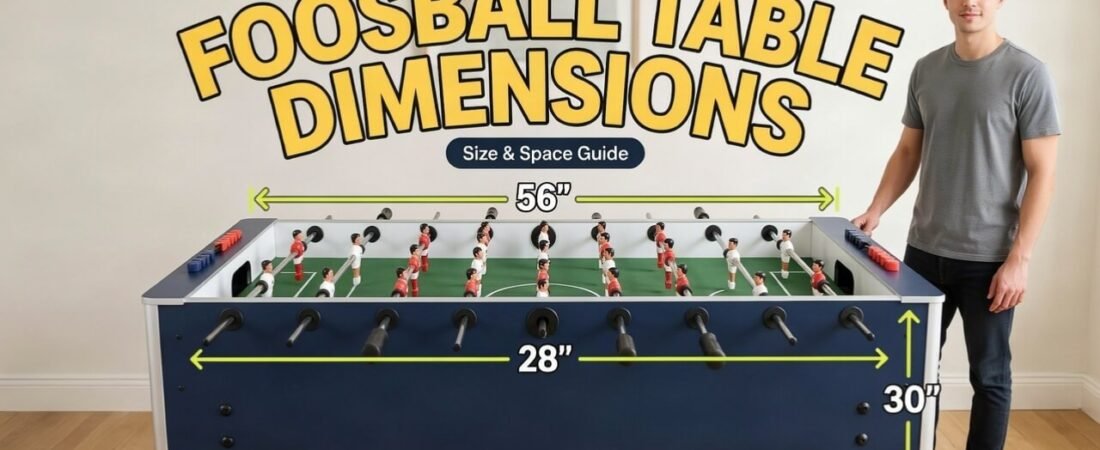
For most full-size adult tables, a useful starting point is approximately 54–56 inches long, 29–30 inches wide, and 34–36 inches high. A commonly used full-size benchmark is 56 × 30 × 36 inches. However, there is no single universal dimension that every foosball table follows, so the manufacturer’s specifications should always be checked before purchase.
The most important point is that the cabinet dimensions are not the same as the space you need to play. Rods and player movement require additional clearance around the table.
Quick Foosball Table Dimensions at a Glance
Here are the measurements most buyers want to know:
| Measurement | Typical Full-Size Range |
|---|---|
| Length | 54–56 inches |
| Width | 29–30 inches |
| Height | 34–36 inches |
| Length in centimeters | About 137–142 cm |
| Width in centimeters | About 74–76 cm |
| Height in centimeters | About 86–91 cm |
| Common benchmark | 56 × 30 × 36 inches |
A full-size table around 56 inches long × 30 inches wide × 36 inches high is a practical reference when planning a game room. Some tables are slightly shorter, narrower, taller, or wider depending on their design.
What Are the Standard Foosball Table Dimensions?
When people search for the standard size of a foosball table, they are usually looking for a full-size table suitable for adults.
A typical full-size foosball table measures approximately:
- 54–56 inches in length
- 29–30 inches in width
- 34–36 inches in height
In metric measurements, that is roughly:
- 137–142 cm long
- 74–76 cm wide
- 86–91 cm high
A 56 × 30 × 36-inch table is one of the most commonly referenced configurations for full-size play.
However, the word “standard” can be misleading. Unlike some sports equipment with one exact worldwide measurement, foosball tables vary between manufacturers and playing styles.
If you are purchasing a table for casual home games, being within this general range is usually more important than finding a table that matches one exact number.
What Is a Regulation Foosball Table Size?
The term regulation foosball table generally refers to a full-size table designed around competitive or tournament-style play.
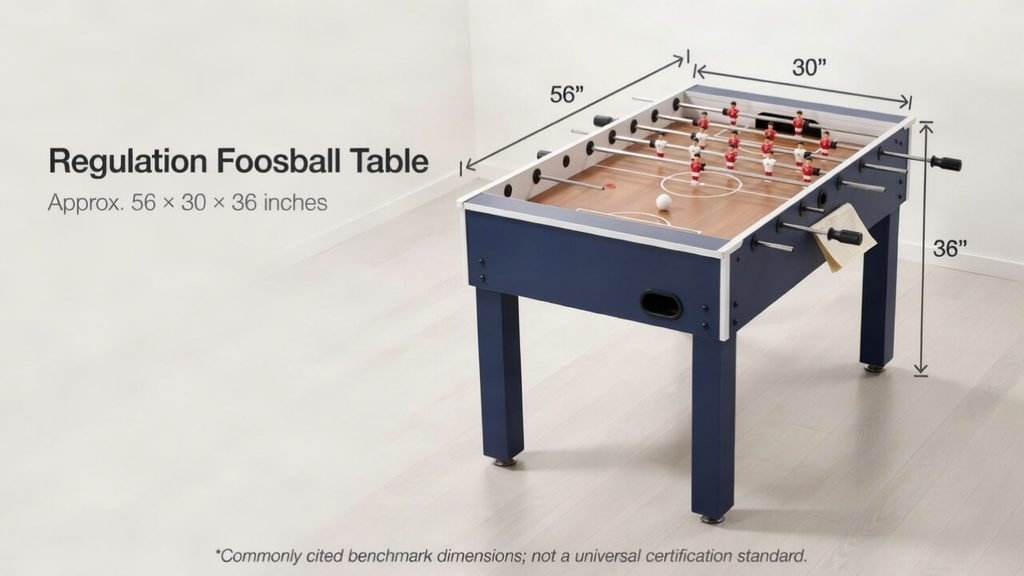
A commonly cited regulation benchmark is approximately:
56 inches long × 30 inches wide × 36 inches high.
But regulation status is about more than the outside dimensions. Competitive tables can differ in construction, playing surface, rod system, player configuration, ball characteristics, and other design details.
For example, tables associated with official competition organizations may have specific requirements beyond simply being 56 × 30 × 36 inches. Some recognized competition tables also use metric dimensions that differ slightly from the familiar American measurements.
So, if you plan to compete, do not rely solely on a product listing saying “regulation size.” Check whether the specific table is approved or recognized for the competitions you intend to play.
For ordinary home use, however, a high-quality full-size table can provide an excellent playing experience without necessarily needing tournament certification.
Foosball Table Dimensions in Inches and Centimeters
If you are comparing products from American and European manufacturers, you may encounter both inches and centimeters.
Here are some useful conversions:
| Inches | Centimeters | Millimeters |
|---|---|---|
| 54 inches | 137.2 cm | 1,372 mm |
| 55 inches | 139.7 cm | 1,397 mm |
| 56 inches | 142.2 cm | 1,422 mm |
| 29 inches | 73.7 cm | 737 mm |
| 30 inches | 76.2 cm | 762 mm |
| 34 inches | 86.4 cm | 864 mm |
| 35 inches | 88.9 cm | 889 mm |
| 36 inches | 91.4 cm | 914 mm |
For example, a 56 × 30 × 36-inch foosball table is approximately 142.2 × 76.2 × 91.4 cm.
These conversions are particularly useful when comparing tables listed by international manufacturers.
How Much Room Do You Need for a Foosball Table?
This is where many buyers make their biggest mistake.
A table measuring 56 × 30 inches does not mean you only need a 56 × 30-inch area in your room.
The rods extend beyond the cabinet, and players need space to stand and operate them. The practical playing area can therefore be substantially larger than the table’s physical footprint.
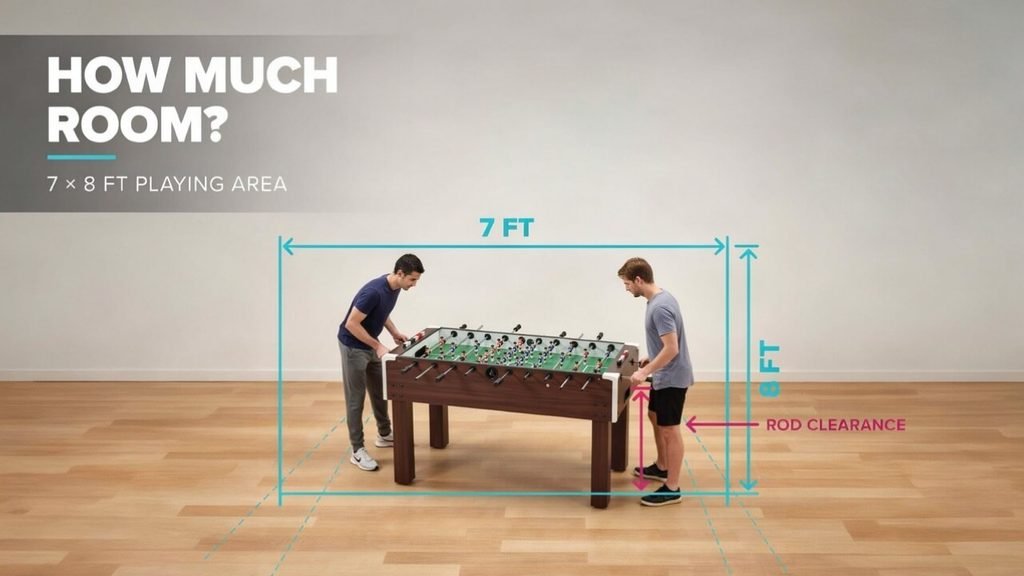
One buyer’s guide, for example, lists a full-size table at 56 inches long and 30 inches wide and recommends at least a 7 × 8-foot playing area, with additional space recommended for larger players.
Other room-planning references recommend even more generous clearance depending on the table and how comfortably you want people to move.
A Practical Room-Size Guide
| Room Size | Suitability |
|---|---|
| 6 × 8 ft | Very tight for a full-size table |
| 7 × 8 ft | Possible with careful positioning |
| 8 × 8 ft | Reasonable for some home setups |
| 8 × 10 ft | Comfortable for many full-size tables |
| 9 × 10 ft or larger | Excellent for comfortable gameplay |
These are planning guidelines rather than universal requirements because rod length and table design vary.
If you have enough space, an 8 × 10-foot or larger area is a much more comfortable target than trying to squeeze a full-size table into the smallest possible room.
Why Rod Clearance Matters
The rods are one of the most overlooked parts of foosball table measurements.
A product listing may tell you that a table is 30 inches wide, but that measurement may describe only the cabinet. The handles and rods extend beyond the cabinet while players are using them.
That means the actual width required during a game can be considerably greater.
Imagine placing a 30-inch-wide table against a wall with only a few inches of space between the wall and the rods. The table technically fits, but the game becomes difficult or impossible to play.
Players need enough room to:
- Rotate the rods comfortably
- Move the rods in and out
- Stand naturally
- Move their arms
- Change positions
- Avoid hitting walls or furniture
- Allow another person to pass behind them
This is why clearance should be measured before buying, not after the table arrives.
How Much Clearance Should You Leave Around a Foosball Table?
There is no single clearance number that works for every table, but a useful planning approach is to allow roughly 2–3 feet of usable space around the playing positions, with more room preferred in busy game rooms.
Some room-planning guides calculate a 56-inch table with approximately 26 inches of side clearance and 36 inches at the ends, resulting in a much larger overall room footprint than the cabinet itself.
For a comfortable home setup, think of the table as part of a larger playing zone rather than an isolated piece of furniture.
The Four Areas to Measure
Before placing your table, consider four areas:
1. Table footprint
Measure the actual length and width of the cabinet.
2. Rod extension
Check how far the rods extend from both sides of the table.
3. Player space
Leave room for people to stand and move their arms.
4. Walking space
If the room is also used for other activities, leave enough space for people to walk around the table without disturbing a game.
Foosball Table Height: Why It Matters
The height of a foosball table affects comfort, especially for adults.
Full-size tables commonly fall in the 34–36-inch height range, with approximately 36 inches being a common benchmark.
A table that is too low can force taller players to bend forward, while an unusually tall table may be uncomfortable for children.
Height is particularly important if several people of different ages will use the table.
Best Height for Adults
For most adult players, a table around 35–36 inches high provides a familiar playing position.
Best Height for Children
Children may find a full-size adult table difficult to use comfortably. Instead of automatically buying a very small table, consider the child’s age, height, and how frequently the table will be used.
A smaller table can be easier for children, but it may not provide the same stability or playing experience as a full-size model.
Full-Size vs. Compact Foosball Tables
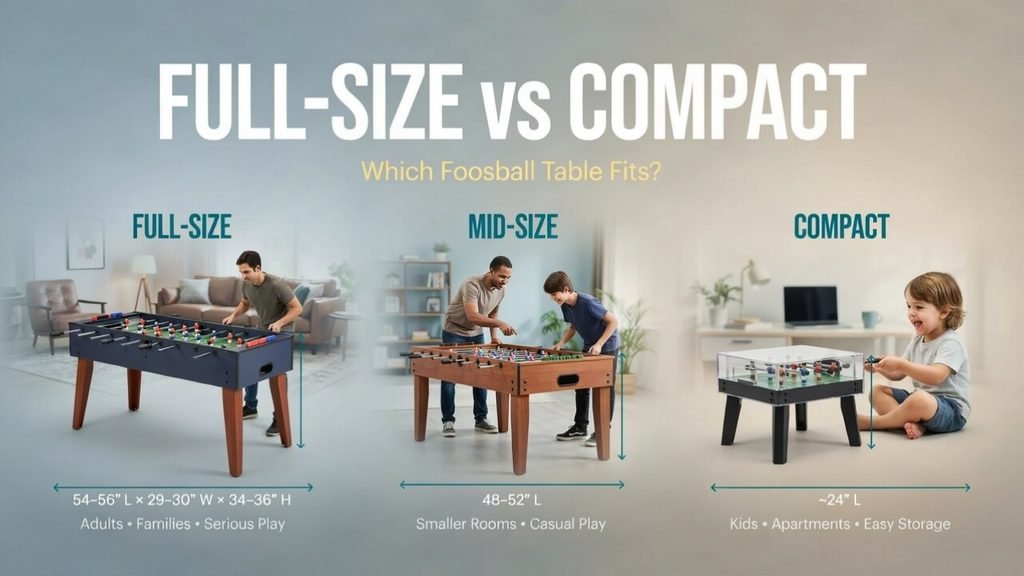
Not every home has room for a 56-inch table.
Compact tables provide an alternative for apartments, bedrooms, offices, smaller recreation rooms, and occasional players.
Full-Size Foosball Tables
Typical dimensions:
54–56 × 29–30 × 34–36 inches
Best for:
- Adults
- Families
- Game rooms
- Regular players
- Serious practice
- Players who want a traditional playing experience
Full-size models are usually the best choice when space allows.
Mid-Size Foosball Tables
Mid-size tables are often around 48–52 inches long, although dimensions vary considerably between manufacturers.
They can be useful for:
- Smaller homes
- Apartments
- Casual family games
- Multipurpose rooms
The main compromise is playing space and stability compared with a quality full-size table.
Compact and Tabletop Foosball Tables
Tabletop models can be dramatically smaller than full-size tables.
They are useful for:
- Children
- Small apartments
- Offices
- Travel
- Occasional games
- Easy storage
However, they are not a direct replacement for a full-size table. Smaller dimensions usually mean a different playing experience, smaller rods, lighter construction, and less stability.
Does a Bigger Foosball Table Mean a Better Table?
Not necessarily.
A larger table can provide a more traditional playing experience, but size alone does not determine quality.
Construction, stability, playing surface, rods, bearings, player figures, leveling system, and overall build quality can have a major impact on gameplay.
For example, a poorly constructed 56-inch table may perform worse than a well-built smaller model.
When shopping, consider the entire design rather than simply looking for the biggest dimensions.
How to Measure Your Room Before Buying a Foosball Table
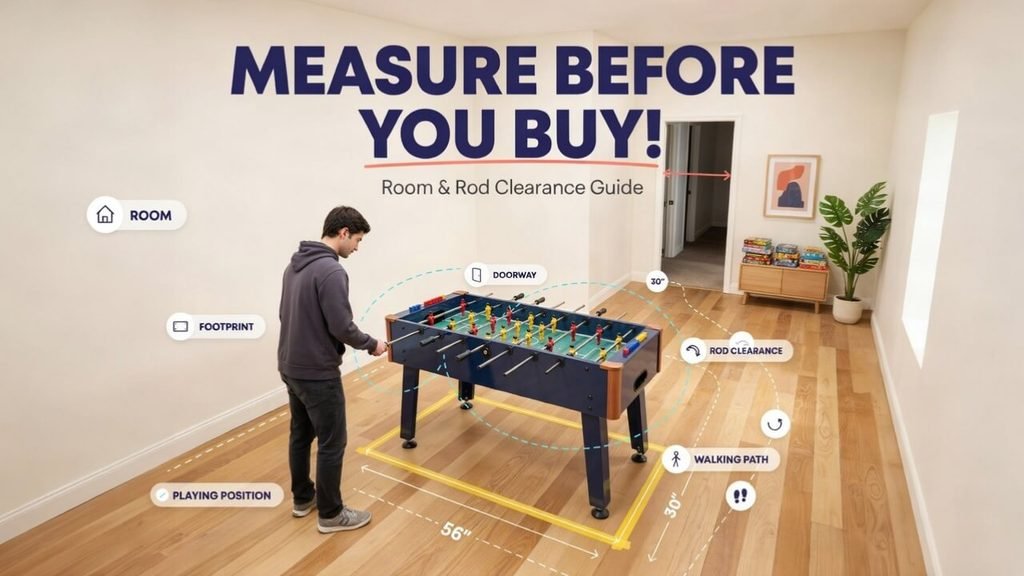
You can avoid most sizing problems with a simple measuring process.
Step 1: Measure the Room
Measure the room’s usable length and width.
Do not include areas blocked by permanent furniture if the table cannot occupy those spaces.
Step 2: Measure the Doorway
Measure the width and height of the entrance.
A table that fits perfectly inside your game room may still be difficult to bring through a narrow doorway.
Also consider:
- Hallways
- Staircases
- Elevator doors
- Tight corners
- Door frames
Step 3: Mark the Table Footprint
Use painter’s tape to mark the dimensions of the table on the floor.
For a 56 × 30-inch table, create a rectangle measuring 56 inches by 30 inches.
Step 4: Mark Rod Clearance
Do not stop at the cabinet.
Add the manufacturer’s stated rod extension or a conservative clearance zone around the sides.
Step 5: Test the Playing Position
Stand where the players would stand.
Pretend to rotate and move the rods.
This simple test can reveal problems that a tape measure alone may miss.
Step 6: Check Walking Paths
Make sure people can still walk through the room without constantly bumping into players or rods.
This matters particularly when the foosball table is placed in a family room or shared recreation area.
How Much Floor Space Does a 56-Inch Foosball Table Need?
A 56-inch table with a 30-inch cabinet occupies only about 11.7 square feet of cabinet footprint.
But that does not represent the usable playing area.
Once you include player clearance and rod movement, the required room can easily become several times larger.
One room-planning example estimates that a standard 56-inch table with appropriate clearance can require an overall area around 6 feet 10 inches by 10 feet 8 inches, depending on the clearance assumptions used.
This is why square footage alone can be misleading.
A narrow room and a square room with the same number of square feet may feel completely different when you place a foosball table inside.
Can You Put a Foosball Table Against a Wall?
You can place a foosball table near a wall, but you should avoid positioning the table so closely that the rods cannot move freely.
The sides where players operate the rods are the most important areas for clearance.
If one side must be closer to a wall, consider whether the table has rod systems that extend differently or whether the manufacturer provides specific placement recommendations.
Ideally, both playing sides should have comfortable access.
Foosball Table Dimensions for a Game Room
A dedicated game room gives you much more flexibility.
For a full-size table, an 8 × 10-foot space or larger is a useful target for comfortable home gameplay.
If you are designing a larger recreation room, you may want even more space because the foosball table will not be the only object occupying the room.
Consider leaving space for:
- Seating
- Storage
- Shelving
- Other game tables
- Walking paths
- Lighting
- Wall-mounted equipment
The goal is not simply to make the foosball table fit. The goal is to make the entire room functional.
Foosball Table Dimensions for Apartments
Apartment owners often have to make a compromise between playing experience and available floor space.
If you have enough room, a compact full-size or mid-size table may be preferable to an extremely small tabletop model.
Before buying, measure:
- The room
- Doorway
- Hallway
- Elevator, if applicable
- Storage location
- Actual playing clearance
A folding or compact model can be particularly useful when the table needs to be stored after use.
Foosball Table Dimensions for Kids
Children do not necessarily need a full-size table.
A smaller table can make it easier for younger players to reach the rods and see the playing surface.
However, parents should consider stability.
Very lightweight tables are convenient to move, but they can shift during aggressive play. If children will use the table frequently, stability can be more important than saving a few inches.
For older children and teenagers, a full-size table may be a better long-term purchase if the room allows it.
Common Foosball Table Dimension Mistakes
Mistake 1: Measuring Only the Cabinet
The most common error is assuming the advertised table dimensions represent the complete playing area.
They often do not account for rod movement and player clearance.
Mistake 2: Forgetting the Doorway
A table can fit inside a room and still fail to get through the entrance.
Always measure the delivery path.
Mistake 3: Choosing the Largest Table Automatically
Bigger is not always better if the room is too small.
A slightly smaller, high-quality table can be more enjoyable than a full-size table squeezed against furniture.
Mistake 4: Ignoring Height
A table should be comfortable for the primary players.
Height becomes particularly important when adults and children will share the table.
Mistake 5: Trusting “Regulation” Without Checking Details
The word “regulation” can be used loosely in product descriptions.
If tournament play matters to you, investigate the table’s actual specifications and competition recognition rather than relying on the marketing label.
What Size Foosball Table Should You Buy?
The best size depends on your available room and how you plan to play.
Choose a Full-Size Table If:
- You have a dedicated game room
- Adults will play regularly
- You want a traditional playing experience
- You have enough clearance
- You may want to practice seriously
A table around 54–56 × 29–30 × 34–36 inches is the safest starting point.
Choose a Mid-Size Table If:
- Space is limited
- You want something for casual games
- You live in a smaller home
- You still want a relatively substantial table
Choose a Compact or Tabletop Table If:
- Floor space is extremely limited
- Children are the main users
- You need easy storage
- The table will only be used occasionally
Frequently Asked Questions About Foosball Table Dimensions
What is the standard size of a foosball table?
A typical full-size foosball table is approximately 54–56 inches long, 29–30 inches wide, and 34–36 inches high. A commonly used benchmark is 56 × 30 × 36 inches.
What are the dimensions of a regulation foosball table?
A commonly referenced regulation-size benchmark is approximately 56 × 30 × 36 inches, although exact specifications can vary among competition tables and organizations.
How much space do you need around a foosball table?
Plan for additional room beyond the cabinet because the rods extend from the sides and players need standing space. A room around 8 × 10 feet or larger is a practical comfortable target for many full-size home setups, although the exact requirement depends on the table design and clearance you prefer.
How tall is a standard foosball table?
Full-size tables are commonly around 34–36 inches tall, with 36 inches being a frequently used benchmark.
How long is a full-size foosball table?
Most full-size tables are approximately 54–56 inches long, although some models fall outside that range.
How wide is a standard foosball table?
The cabinet of a typical full-size table is approximately 29–30 inches wide. Remember that the rods extend beyond the cabinet, so the actual playing width is larger.
Can a foosball table fit in a 7 × 8-foot room?
It may be possible depending on the exact table and rod clearance, but it will be relatively tight. A buyer’s guide lists 7 × 8 feet as a minimum suggested playing area for a full-size 56 × 30-inch table.
Is a 56-inch foosball table considered full size?
Yes. A 56-inch-long table is commonly considered a full-size foosball table, particularly when its width and height are around 30 and 36 inches respectively.
Are all foosball tables the same size?
No. Foosball tables are available in full-size, mid-size, compact, folding, tabletop, and children’s designs. Dimensions can vary significantly between manufacturers.
Final Thoughts on Foosball Table Dimensions
The most useful number to remember is 56 × 30 × 36 inches. That is a good reference point for a full-size foosball table, but it should not be treated as a universal measurement for every model.
For most buyers, the better approach is to think about three separate measurements:
The table: approximately 54–56 × 29–30 × 34–36 inches for a typical full-size model.
The rods: additional side space is required for the handles and player movement.
The room: ideally large enough to allow comfortable play, walking space, and access around the table.
Before ordering, measure the room, doorway, delivery path, and playing area. Then mark the proposed table footprint on the floor and test the available clearance.
A table that technically fits is not necessarily a table that plays well.
If you have enough space, a quality full-size table around 56 × 30 × 36 inches offers the most familiar experience for adult and family players. If space is limited, a well-designed compact or mid-size table may be the smarter choice.
The best foosball table is ultimately not the biggest one you can buy—it is the one that fits your room while leaving enough space for everyone to play comfortably.